Environmental Offset Planting & Revegetation Services - South East Queensland

Cambium Land Management provides qualified ecological restoration and vegetation management services for development projects, rehabilitation programs, and environmental compliance work across South East Queensland.

We work directly with environmental consultants, project managers, civil contractors, and developers to implement vegetation management outcomes that meet Queensland regulatory requirements and align with the SEQ Ecological Restoration Handbook framework.

Our team brings licensed herbicide application, commercial-grade machinery, and documented site management experience to projects of all scales across the Greater Brisbane region, Scenic Rim, Logan, Ipswich, Lockyer Valley, and surrounding areas.

Environmental Offset Planting & Native Revegetation for SEQ Development Projects

Cambium Land Management delivers environmental offset planting and native revegetation programs for development projects with biodiversity offset obligations across South East Queensland.

We install and maintain locally-provenant native revegetation aligned with SEQ Ecological Restoration Handbook guidance, regional ecosystem targets, and the requirements of Queensland's Environmental Offsets Act 2014 framework.

From species sourcing and site preparation through to establishment maintenance and compliance reporting, we manage offset planting programs as a single-contractor service.

Environmental Offsets in Queensland - The Basics

Under Queensland's environmental offsets framework, development projects that impact on matters of state environmental significance (MSES) may be required to deliver offset outcomes to compensate for that impact.

Offset obligations are attached to development approvals as conditions and typically specify:

  • The regional ecosystem or vegetation community to be offset

  • The required area or number of stems to be established

  • Performance criteria for establishment (survival rates, cover thresholds, weed cover limits)

  • Reporting requirements and sign-off processes

  • The location and tenure of offset areas

Meeting offset conditions requires more than purchasing land or planting trees. It requires delivering measurable ecological outcomes - vegetation establishment that meets specified performance criteria - within the timeframes set by your approval conditions.

That's where we come in.

Our Offset Planting Services

Species Sourcing & Supply

Offset obligations typically require locally-provenant species - that is, plants grown from seed collected within the relevant regional ecosystem and bioregion.

We source tubestock from reputable SEQ native nurseries with demonstrated local provenance supply chains. Where specific regional ecosystem targets are specified in your offset conditions, we confirm species availability and provenance before committing to installation schedules.

We do not substitute non-local species without explicit agreement from the supervising ecologist or approval authority.

Site Preparation & Weed Control

Offset planting into uncontrolled weed infestations is one of the most common reasons offset programs fail performance criteria. Adequate site preparation is not optional.

Our site preparation approach follows SEQ Ecological Restoration Handbook sequencing:

  • Initial site assessment against regional ecosystem baseline condition

  • Priority weed species identification and mapping

  • Staged threat abatement prior to revegetation installation

  • Soil preparation appropriate to target regional ecosystem

  • Erosion and sediment control measures where required

  • Mulching of planting zones to reduce weed competition during establishment

Revegetation Installation

We install revegetation programs to the densities, species compositions, and structural configurations specified in your offset conditions or consultant-prepared planting plans.

Installation includes:

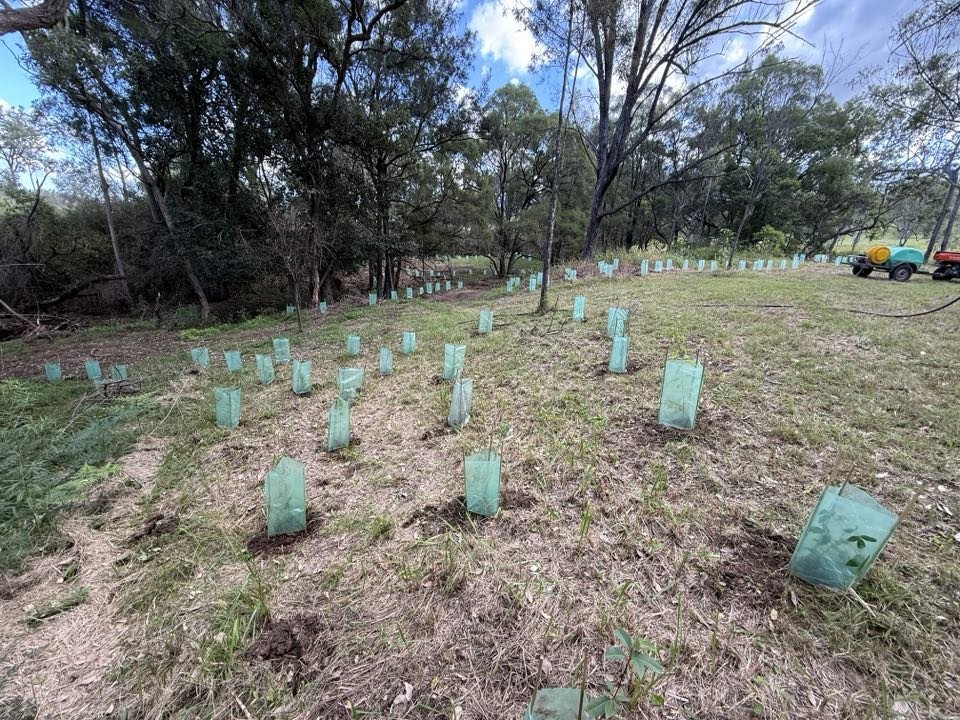
  • Tubestock planting to specified densities (typically 1,000-2,500 stems per hectare for restoration plantings)

  • Appropriate tree guard installation

  • Mulching around individual plants or across planting zones

  • Stock exclusion fencing where grazing pressure is present

  • Watering during critical early establishment period

  • Photographic record of installation for compliance documentation

Establishment Maintenance Programs

The period between installation and performance criteria sign-off typically spans 2-5 years. Establishment maintenance determines whether your offset investment meets its performance targets.

Our establishment maintenance programs include:

Year 1 - Critical Establishment

  • Monthly or bi-monthly site visits during growing season

  • Weed control within planting zones

  • Watering support during extended dry periods (where feasible)

  • Plant replacement for mortalities to maintain density targets

  • Pest and disease monitoring

  • Photo-point monitoring and progress records

Years 2-3 - Consolidation

  • Quarterly site visits

  • Ongoing weed control as canopy develops

  • Targeted plant replacement

  • Monitoring of canopy closure and cover development

  • Progress reporting against performance criteria

Years 4-5 - Performance Criteria Assessment

  • Structured monitoring against approval conditions performance criteria

  • Final vegetation assessments

  • Documentation package compilation for consultant sign-off

  • Handover to long-term land management program

Compliance Documentation & Reporting

Offset compliance requires evidence. We provide structured documentation from installation through to performance criteria sign-off:

  • Photo-point monitoring records from consistent locations at every site visit

  • Plant survival and density assessments at 3, 6, and 12 months, then annually

  • Weed cover assessments against performance criteria thresholds

  • Native cover assessments against target thresholds

  • Species lists for all planted species and any natural regeneration detected

  • Treatment records for all weed management activities

  • Progress reports formatted for submission to approval authority or supervising consultant

Species Selection - SEQ Ecological Restoration Handbook Alignment

Species selection for offset plantings must align with regional ecosystem targets relevant to your offset area. We work with reference to the SEQ Ecological Restoration Handbook framework for:

  • Identifying appropriate regional ecosystem targets for the offset location

  • Selecting species from the relevant structural categories (canopy, sub-canopy, understorey, groundcover, vine)

  • Proportioning species mixes to reflect target regional ecosystem structure and composition

  • Prioritising locally-provenant seed sources appropriate to the regional ecosystem and bioregion

We work from consultant-prepared species lists where these are provided. Where species selection is not specified in your approval conditions, we prepare species lists for consultant review and approval before ordering stock.

Common Offset Vegetation Communities in SEQ

We have experience with offset planting programs targeting a range of SEQ regional ecosystems including:

Riparian and Wetland Communities Creek lines, drainage corridors, and wetland margins. Typically dominated by riparian species with high structural diversity requirements. Demanding establishment conditions requiring careful weed management and moisture-sensitive species handling.

Dry Sclerophyll Woodland Eucalypt-dominated open woodland communities across the SEQ hinterland. Species-rich understorey requirements. Establishment maintenance focused on exotic grass control.

Subtropical Rainforest and Vine Thicket Closed canopy communities on fertile and/or sheltered sites. Complex structural requirements across multiple strata. Typically high tubestock costs reflecting species diversity requirements.

Grassland and Grassy Woodland Groundcover-dominated communities with scattered trees. Exotic grass control is the dominant management challenge. Establishment maintenance intensive in early years.

Offset Delivery Models

Direct Delivery on Title

Where offset conditions require delivery on the development title or on a separately secured offset area, we manage the full program from site preparation through to compliance sign-off.

Offset Area Management

For projects with separately acquired offset properties, we provide ongoing vegetation management including weed control, revegetation, and monitoring under long-term management agreements.

Contractor-to-Consultant Model

Where a supervising ecologist is managing offset delivery and requires an on-ground implementation contractor, we work within that structure - implementing prescriptions, reporting back, and flagging site conditions that require consultant input.

Why Offset Planting Programs Fail

Understanding why offset programs fail helps us design programs that don't:

Inadequate threat abatement before planting The single most common reason. Weeds outcompete planted species before canopy establishes. Result: failed performance criteria, remediation costs, program delay.

Wrong species for site conditions Species selected from a list without reference to actual site conditions - soil type, drainage, aspect, disturbance history - fail to establish or grow poorly. Result: poor survival rates, failed density criteria.

No establishment maintenance Installation-only contracts with no provision for ongoing weed control and plant replacement routinely fail. The offset area returns to weed cover. Result: failed performance criteria, weed reinfestation, full replanting required.

Inadequate documentation from day one Approval authorities require evidence of continuous management. Records assembled retrospectively are incomplete and don't satisfy reporting requirements. Result: compliance risk, program extension, potential enforcement action.

Our programs are designed to avoid all four failure modes.

Commercial Contract Structure

We offer offset planting programs under two primary contract structures:

Full-program contracts Single contract covering site preparation, installation, and multi-year establishment maintenance through to performance criteria sign-off. Fixed scope with scheduled site visits and reporting. Preferred for projects with clear performance criteria and defined timeframes.

Staged contracts Separate contracts for installation and establishment maintenance phases. Suitable for projects where funding approvals or program timelines require staged contracting. We provide indicative costings for all stages upfront.

All commercial contracts include:

  • Defined scope of works and performance obligations

  • Scheduled site visit program

  • Documentation and reporting deliverables

  • Insurance and compliance documentation

  • Clear variation and change management processes

Avant 745 flail mower clearing overgrown acreage in Scenic Rim

Who we work for

Project Enquiries

To discuss an environmental offset planting project, please contact us with:

  • Project location and offset area details

  • Relevant approval conditions or offset obligation summary

  • Regional ecosystem target (if specified)

  • Required performance criteria

  • Anticipated program timeline

  • Supervising consultant contact (if appointed)

We provide written proposals for offset planting programs within 3 business days of receiving project details.

Frequently Asked Questions

Do you source locally-provenant tubestock? Yes. We source tubestock from nurseries with documented local provenance supply chains appropriate to SEQ regional ecosystems. We confirm provenance before ordering for offset planting programs.

What densities do you typically plant to? Planting densities depend on the regional ecosystem target and performance criteria specified. Typical restoration planting densities range from 1,000 to 2,500 stems per hectare. Your approval conditions or supervising ecologist will specify the applicable density.

Can you provide ongoing management after performance criteria are achieved? Yes. We offer long-term vegetation management agreements for offset areas following compliance sign-off. This provides continuity of site knowledge and ongoing weed management to protect the ecological outcomes achieved.

How do you handle stock losses during establishment? Plant replacement for mortalities is included in our establishment maintenance programs. We assess survival rates at regular intervals and replace plants as required to maintain the densities specified in your approval conditions.

Can you work on offset areas with existing native vegetation? Yes. Where offset areas contain existing native vegetation requiring weed management to improve condition, we implement weed control programs alongside or instead of revegetation, depending on site condition and restoration potential.

What if site conditions are significantly different from what the RMP or offset conditions assumed? We flag significant site condition variations to the supervising consultant promptly. Adaptive management in response to unexpected site conditions is normal in restoration programs. We document all adaptive management decisions and rationale for the compliance record.

Servicing South-East Queensland from our Central Hub

We service environmental offset programs throughout South East Queensland within approximately 1.5 hours of our Rocklea depot:

  • Logan City and Scenic Rim growth corridors

  • Ipswich City and Lockyer Valley

  • Brisbane City acreage and bushland interface areas

  • Redland City

  • Somerset and Brisbane Valley

Related Commercial Services

What our customers say.

  • "I would highly recommend Mitchell from Cambium Land Management. He was thorough, friendly and nothing was too difficult for him. Always smiling, many thanks Mitchell"

  • "Mitchell was communicative and did everything he said he would, kept me up to date and explained everything every step of the way. Did a great job in clearing all the invasive weeds and trees from my backyard leaving it looking professional and tidy."

  • "Cambium Land Management has completely transformed the appearance of our commercial property. Their team is professional and reliable. It is such a relief not having to worry whether the gardeners are going to rock up. Highly recommend them for any business needing reliable and top-notch garden maintenance!"